The Tax System Was Built for Human Labor


The Tax System Was Built for Human Labor
The most common argument about AI and redistribution begins at the end.
Will governments need universal basic income if machines perform much of today’s work?
A July 13 discussion on the Moonshots podcast offered a more useful starting point. The panel reframed UBI as a question of productive capacity and distribution, then named several possible mechanisms: a negative income tax, an automation dividend, and public or sovereign ownership of productive assets.
One line compressed the argument too far: “We tax labor and we don’t tax capital.” Governments do tax corporate profits, dividends, interest, capital gains, property, and estates. The actual asymmetry is subtler—and more consequential.
Labor taxes are large, routine, difficult to move across borders, and often collected automatically through payroll. Capital income is taxed through narrower and more variable systems, frequently at preferential rates, with greater opportunities for deferral, reclassification, and international mobility. Social insurance in many countries is tied directly to wages and employment.
If AI shifts income from payroll toward capital, intellectual property, and economic rents, the problem is not that the tax system has never heard of capital.
It is that much of the state was financed and administered around a human job.
The Payroll Architecture
Across OECD countries, taxes on labor—including personal income tax, employer and employee social contributions, and payroll taxes—form a major share of government revenue. They are also integrated into the operating machinery of employment. Employers calculate liabilities, withhold money, and transmit it on a predictable schedule.
The same payroll relationship frequently determines access to unemployment insurance, pensions, disability coverage, health benefits, and paid leave. Work is not only a source of private income. It is the routing layer through which households enter public insurance systems.
Capital income is taxed too, but differently. The OECD notes that interest, dividends, and capital gains often receive preferential treatment relative to labor income. Capital is also concentrated among higher-income households and can be held through complex legal forms or across jurisdictions.
These differences matter even before large-scale automation. The OECD’s work on social protection and technological change observes that lower effective taxes on capital than labor can act as an implicit automation subsidy: replacing a worker may remove payroll-linked obligations that do not apply to a machine.
AI intensifies the issue because its productive unit is difficult to define. Is one “robot” a physical machine, a software agent, a model subscription, an inference cluster, or a workflow that combines all four?
The tax base cannot be rebuilt by placing a meter on each artificial worker.
The Distribution Question Comes Before UBI
Automation can increase output while distributing its gains unevenly. Owners of the systems may receive higher profits and market rents. Workers whose tasks are automated may face displacement or weaker bargaining power. Other workers may become more productive and earn more because AI complements their skills.
The aggregate employment result remains uncertain. Historical automation eliminated tasks and created new ones; AI may do both at a different speed and across a wider range of cognitive work. An OECD review notes the potential for AI to raise capital’s share of income, while also emphasizing uncertainty about how new tasks, demand, and adoption patterns will affect employment.
This uncertainty changes the policy sequence.
UBI is one possible transfer design. It does not specify the tax base that finances the transfer, the ownership of the productive assets, or which existing benefits it replaces. Two UBI systems with the same monthly payment can have very different distributional effects if one is financed by a broad consumption tax and another by taxes on excess profits or capital gains.
The prior questions are:
- Where does income accrue after automation?
- Which parts of that income can governments tax reliably?
- Who owns the systems generating it?
- Which benefits should remain tied to employment?
The transfer comes after those choices, not before them.
Why a Robot Tax Is Hard
A robot tax has intuitive clarity. If a machine replaces a taxable worker, tax the machine and use the revenue to support displaced people.
The clarity fades during implementation.
Modern automation is often software embedded throughout a production process. A customer-service model may handle part of a conversation before handing it to a person. A coding agent may raise one engineer’s output without eliminating a specific job. A warehouse may combine conventional machinery, computer vision, and human supervision. Defining the taxable robot invites arbitrary boundaries and encourages firms to redesign contracts around them.
The economic tradeoff is equally important. An IMF model of automation taxes found that a robot tax was the strongest of several studied tools for reducing inequality in the short run because it slowed the replacement of lower-skilled labor. The same mechanism reduced long-run robot accumulation, productivity, and output.
That does not make a robot tax irrational. A society may accept lower measured output to reduce transition costs or preserve employment. It does mean the instrument works partly by discouraging the technology whose gains are supposed to finance the new settlement.
The IMF’s later guidance on generative AI therefore recommends against a specific AI tax, arguing that it would be difficult to target and could suppress investment and innovation.
Taxing Capital, Profits, and Rents
An alternative is to tax the income produced by automation rather than count the automated units.
This can take several forms.
Corporate income tax reaches profits at the firm level. International coordination matters because model providers, intellectual property, and digital services can cross borders more easily than workers can.
Personal capital-income taxation reaches dividends, interest, and realized capital gains received by owners. Its effectiveness depends on rates, enforcement, deferral rules, and the treatment of unrealized gains.
Excess-profit or rent taxation targets returns above a normal competitive profit. This is especially relevant if AI markets concentrate around scarce compute, proprietary data, dominant platforms, or network effects. In the IMF automation model, taxing excess profits offered a comparatively efficient way to address the inequality-growth tradeoff because it focused on market power rather than the productive machine itself.
Removing automation-biased tax preferences would reconsider accelerated deductions or credits that favor software and equipment over employing people. The goal is tax neutrality, not making labor artificially cheap or machines artificially expensive.
These instruments avoid defining a robot. They inherit the familiar problems of capital taxation: valuation, avoidance, profit shifting, volatility, and political competition for investment.
AI does not eliminate tax administration. It raises the value of getting it right.
Ownership Is a Distribution System
Taxation is not the only route by which automation gains can reach the public.
A sovereign wealth fund or public investment fund can hold equity and distribute part of the return. Alaska’s Permanent Fund is the familiar resource-based example; an AI-era version could be capitalized through public investment, spectrum or data-center leases, equity received in exchange for subsidies, or a share of rents from publicly supported research and infrastructure.
An automation dividend funded by ownership differs from a transfer funded by annual taxation. The public participates in the upside as an asset holder rather than only collecting revenue after profits appear.
This design also carries risks. Governments must decide which assets to own, how funds are insulated from political favoritism, whether domestic investment mandates reduce returns, and which generation receives the benefits. Public ownership can distribute gains broadly or become another concentrated institution with weak accountability.
Private ownership can be broadened as well. Pension funds, employee equity, cooperative structures, and diversified household investment all change who receives capital income before the tax system intervenes.
The ownership question is therefore not separate from redistribution. It determines how much redistribution is necessary.
Negative Income Tax, UBI, and Employment-Linked Benefits
A negative income tax provides cash through the tax system as earnings fall below a threshold, then phases the payment out as income rises. It targets support more narrowly than a universal payment and can be integrated with existing income reporting. Phase-out rates can create high effective marginal taxes if poorly designed.
UBI pays everyone, avoiding eligibility cliffs and administrative judgments about who deserves support. Its gross cost is large, though the net distributional cost depends on the taxes used to recover payments from higher-income households and which programs it replaces.
Wage insurance, expanded unemployment insurance, portable benefits, and direct social assistance address different transition patterns. If AI displaces people temporarily, insurance and retraining may be more responsive than a permanent universal payment. If stable employment becomes structurally scarce, systems tied to job loss and job search may become increasingly artificial.
The IMF recommends stronger unemployment insurance, broader social assistance, portable entitlements, and preparation for highly disruptive scenarios rather than assuming one employment forecast. This flexibility is important because the same AI capability can augment work in one institution and replace it in another.
The durable principle is weaker dependence on a single formal employer for access to basic protection.
A Tax Base for an Uncertain Transition
The strongest policy package is unlikely to be one instrument.
A resilient approach would combine:
- reduced tax distortions that favor replacing labor solely for fiscal reasons;
- stronger taxation of personal capital income and capital gains where current systems are preferential or porous;
- coordinated corporate taxation and enforcement against profit shifting;
- targeted taxation of excess profits and economic rents where market concentration produces them;
- broader ownership of productive assets through public, pension, employee, or household channels;
- portable social insurance and cash-transfer systems that remain functional when employment becomes irregular;
- periodic adjustment as evidence clarifies whether AI is primarily augmenting workers, displacing them, or doing both across different sectors.
This approach does not require a confident forecast of mass unemployment. It treats the tax base as infrastructure that should survive several plausible futures.
The debate over UBI will continue because it compresses a complicated transition into a visible monthly number. The deeper design problem is less visible: how a society collects and distributes claims on production when production no longer maps cleanly onto hours of human labor.
The existing system taxes capital. It taxes labor more automatically, funds much of social insurance through it, and builds public eligibility around the job.
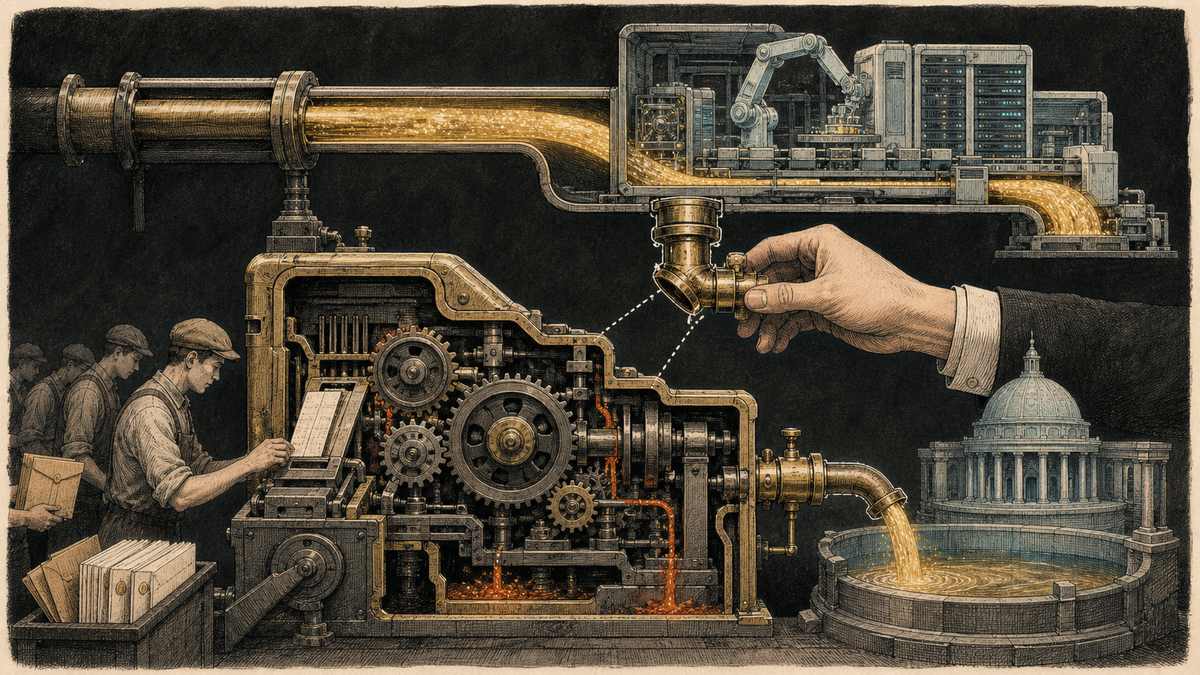
AI may not abolish work. It is already enough to expose how much of government assumes work will remain the same kind of pipe.
Sources
- Moonshots with Peter Diamandis
- OECD, “Personal and Property Taxes”
- OECD, “Megatrends and the Future of Social Protection”
- OECD, “The Impact of Artificial Intelligence on Productivity, Distribution and Growth”
- IMF, “Sharing the Gains of Automation: The Role of Fiscal Policy”
- IMF, “Fiscal Policy Can Help Broaden the Gains of AI to Humanity”